
Douglas County Ovens
Wall Oven & Range Oven Repair in Castle Pines
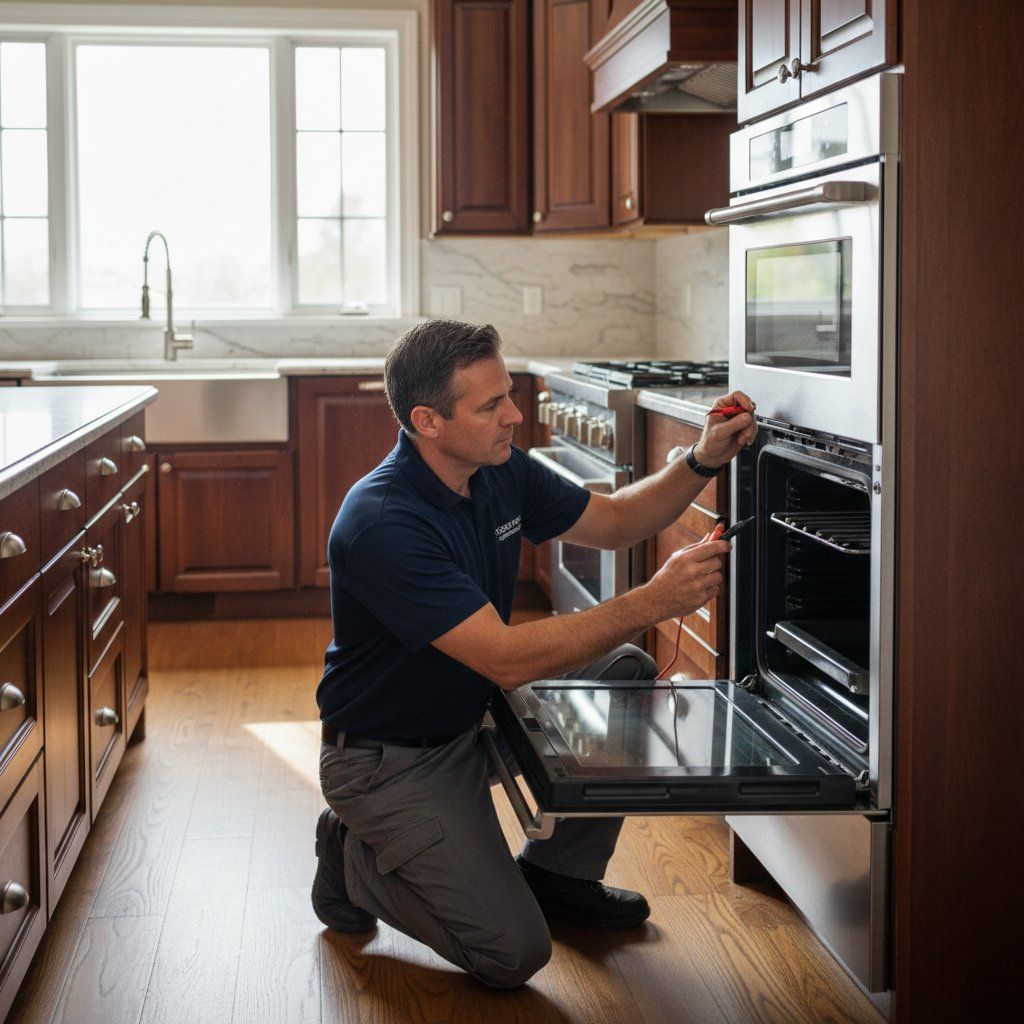
Ovens in Castle Pines come in two flavors: the workhorses installed when the older subdivisions went up, and the high-spec wall ovens dropped into recent luxury remodels. Both drift out of calibration, and both tend to fail on the day you have people coming over.
We repair wall ovens and range ovens across the 80108 area, from temperature and element faults to the self-clean lockouts and F-codes that leave a door sealed shut at the worst possible moment.
Two Generations of Kitchens, One Standard of Repair
Castle Pines and the neighborhoods just north of it hold a real mix of ovens. Many homes in the established parts of Highlands Ranch still run the original ranges and wall ovens from when the community was built, while the newer estate remodels off I-25 carry premium convection wall ovens with sophisticated control boards.
We fix both with the same care. An older oven often needs nothing more than a fresh bake element and a recalibration to bake true again, while a newer wall oven may need its temperature sensor or control board diagnosed against the actual cavity heat. Knowing which era of appliance we're walking into means we arrive with the right approach.
Common Oven Problems We Repair
If your oven is doing any of the following, it's telling you a specific part is on its way out. These are the faults we see most across both older and newer Castle Pines kitchens.
Won't reach the set temperature
A failed bake element or a sensor reading high leaves the cavity running cool, so roasts take longer and baking comes out dense.
Uneven or slow baking
A tired element or a stalled convection fan means one rack browns while another stays pale, and preheats stretch far longer than they should.
Door locked after self-clean
A door lock motor or thermal fuse that fails under self-clean heat can leave the door sealed shut until the lock is released and replaced.
F-code errors on the display
Fault codes usually flag a sensor out of range or a stuck lock. The oven may refuse to heat until the underlying fault is cleared.
Broiler won't fire
When the broil element burns through, the top of the cavity stays cold even though bake mode still works, so anything meant to brown never does.
Fan runs constantly
A convection or cooling fan that never shuts off points to a stuck relay or thermostat and shortens the fan motor's life if ignored.
Quick Answers
- Why is my oven not reaching the temperature I set?
- The most common causes are a burned-out bake element, a drifting temperature sensor, or a control board that misreads the sensor. An oven can look like it's working while running fifty degrees cool. A technician verifies actual cavity temperature with an independent probe on-site; call (303) 729-0972 to book.
- My oven door locked after self-cleaning and won't open. Can you help?
- Yes, this is one of the most frequent calls we get. Self-clean runs the cavity extremely hot, and a failed door lock motor or a heat-tripped thermal fuse can leave the door latched. We release it safely and replace the failed lock or fuse so it doesn't recur. Book at https://nexfield.pro/crm/book?u=33 or call anytime.
- Do you repair both older Highlands Ranch ovens and newer luxury wall ovens?
- We do. We service the builder-grade ranges from the area's established neighborhoods as well as the premium wall ovens in newer Castle Pines remodels. Parts and diagnostics differ between them, and we come prepared for both. Every visit begins with the same flat $89 diagnostic.
Clear Oven Repair Estimates
We charge a flat $89 to diagnose. The figures below are starting points only; your exact repair price is set after the technician inspects the oven and confirms the failed part on-site.
All prices are starting estimates. The exact cost is determined only after an on-site inspection, since every appliance, model and fault is different.
Why Calibration Matters More Than It Sounds
Most people assume an oven is either working or broken, but the more common reality is one that has quietly drifted. A cavity running thirty or forty degrees off its setpoint won't throw an error; it just turns reliable recipes into guesswork, dries out roasts, and leaves cakes under-baked in the center. When we service an oven we verify the true temperature with an independent probe, not the display, so we can tell whether the fix is an element, a sensor, or a calibration adjustment.
Elevation adds a subtle layer here. At roughly 6,280 feet, baking already behaves differently than at sea level, so an oven that's also running cool compounds the problem and makes every result feel unpredictable. Whether your oven came with the house two decades ago or arrived in last year's remodel, the goal is the same: an appliance that hits the number on the dial and holds it. Call (303) 729-0972 or book online and we'll get it back to baking true.
Frequently Asked Questions
My oven bakes unevenly, browning one side more than the other. What causes that?
Uneven baking often traces to a weak bake element, a convection fan that has slowed or stopped, or a temperature sensor reading high. In newer convection wall ovens the fan is usually the culprit; in older ranges it is more often the element itself.
What does an F-code on the display mean?
F-codes are fault codes the control board sets when it detects a problem, most often a sensor out of range or a stuck door lock. The specific number narrows it down. We read the code, confirm what it points to, and fix the underlying fault rather than just clearing the display.
The convection fan runs constantly, even when the oven is off. Is that a problem?
A cooling fan running after use is normal for a while. A fan that never stops usually means a control relay stuck closed or a thermostat that isn't releasing. It is worth addressing before the motor wears out from running around the clock.
Is it safe to keep using an oven that heats slowly?
A slow-heating oven is usually safe but rarely gets better on its own, and it throws off every recipe in the meantime. Slow heat points to a degrading element or a sensor drifting out of spec, both of which are straightforward to replace once diagnosed.
Should I run self-clean before a technician visits?
We suggest holding off. Self-clean puts the most heat stress of any cycle on the door lock, wiring and control board, and it is a common trigger for the exact failures we get called about. If the oven already has a fault, running it can make things worse.
What Highlands Ranch neighbors say
Called just before six in the morning fully expecting to leave a voicemail, and a real person picked up. Our garage freezer had quit overnight in the June heat with half a side of beef sitting in it — the condenser fan had seized solid, and he already had the replacement with him, so it was done in one visit. Not a thing thawed, and he was decent enough not to comment on the state of the garage.
I had already started pricing new dishwashers. Every glass was coming out of the Miele with a chalky grey film on it and nothing I ran through the machine made any difference. The real culprit was our hard Douglas County water: scale baked hard onto the heating element, and a spray-arm bearing worn enough to wobble. He descaled it, fitted the new bearing, and corrected a water softener setting that had apparently been wrong since the house was built — clear glassware again, for a small fraction of a replacement.
Sixty-two degrees is not where you want a cabinet of reds sitting, and by then the display had gone dark as well. A power blip earlier that month had cooked the control board; he confirmed that on the first visit, got the correct board, and fitted it a couple of days later. What I appreciated more was that he then set a target temperature our basement can genuinely hold — at 6,200 feet it swings far more than people expect — rather than leaving it on a number that would have the compressor fighting all year.
The griddle on our Wolf had gone from useful to useless, scorching eggs on one pass and barely setting them on the next. He put a meter on it, found the griddle plate thermostat reading well outside its range, and swapped it. Then he checked the oven calibration while he was in there without my asking, which up here matters more than most people realise. The invoice matched the number he gave me before he started, to the dollar.
Every couple of weeks we were chipping a sheet of ice off the freezer floor and mopping up after it. The drain-line heater had failed, so defrost water was refreezing before it ever reached the drain — a genuine part went in and the ice has not come back once since. He also pulled the grille and showed me how much dust a Westridge summer packs into the condenser, which I now vacuum on a schedule.
The humidity control in our undercounter wine drawer stopped regulating and the corks were starting to dry out. I have to be honest about the scheduling: we were given an arrival window twice and both times they turned up well outside it without a phone call, so an afternoon went to waste. The technician himself was excellent — he explained what the humidity module actually does, fitted the replacement, and it has held steady ever since. Good work, but the dispatching needs tightening up.
Ready to get your appliance fixed?
Call our 24/7 line or book online. We perform repairs daily 8 AM–6 PM across Highlands Ranch and nearby areas — with a flat $89 service call.
Calls answered 24/7 · No email or forms — just call or book online.