
Castle Rock, CO
Wine Cooler Repair for Castle Rock Homes
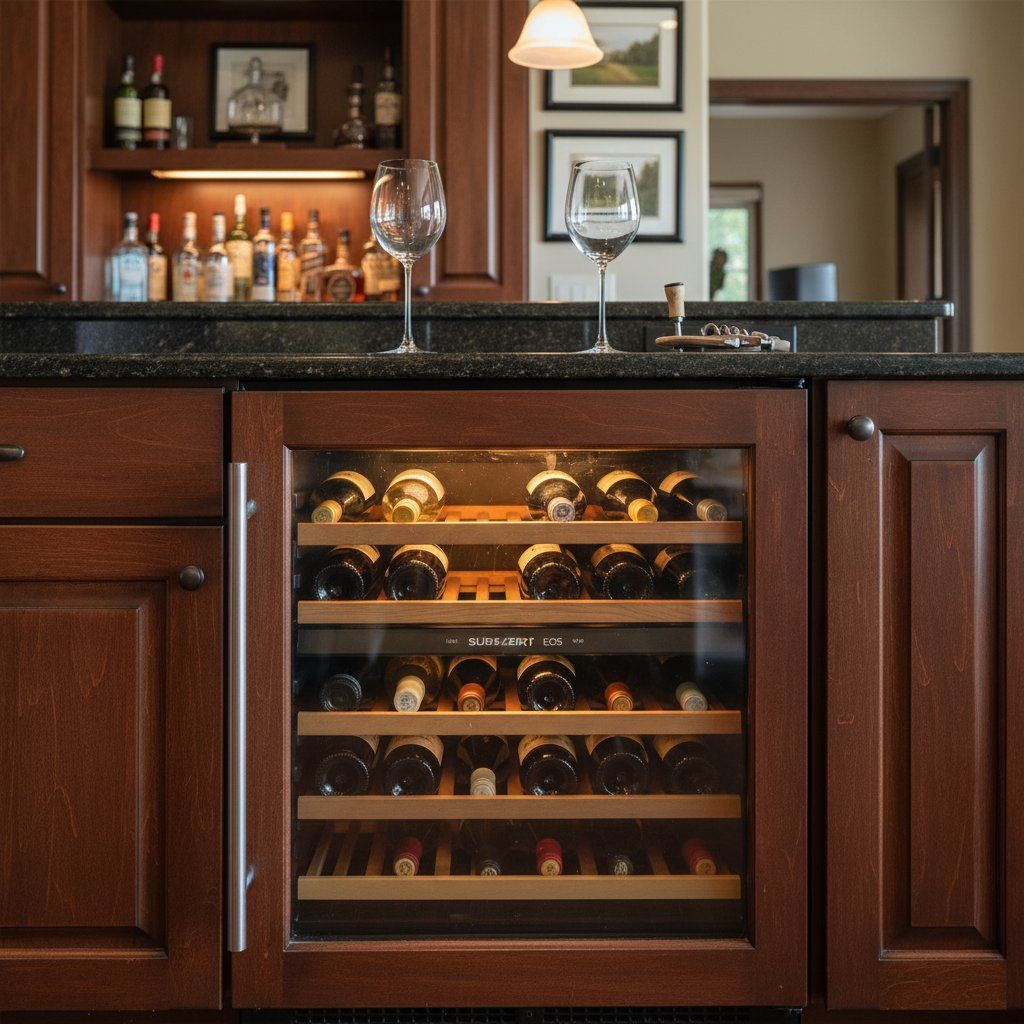
A wine cooler is supposed to disappear into the cabinetry and hold a quiet, steady chill. When it starts fogging up, drifting off temperature, or humming louder than the room, that silence is worth getting back.
We service single-zone, dual-zone, and fully integrated wine columns throughout Castle Rock and the rest of Douglas County.
Why Castle Rock wine coolers act up
A wine cooler is a quieter, fussier machine than the refrigerator beside it, and in Castle Rock that fussiness surfaces fast. At roughly 6,224 feet, the Douglas County seat sits high and dry, so the air a built-in unit pulls across its coils is thinner than what the model was bench-tested on. Whether your storage lives in an older home near Wilcox Street or a newer build out in The Meadows or Cobblestone, the cooler is working to hold a steady 55 degrees while the room around it swings with the seasons.
Then there is the water. Douglas County kitchens are known for hard, mineral-heavy tap water, and it quietly works against wine storage in a way owners rarely connect. When a zone runs cool, humidity condenses on the evaporator plate and the rear interior wall; wipe those surfaces with tap water and the minerals stay behind as a chalky film. Over months that scale narrows the small drain channel at the base of the cabinet, so meltwater pools instead of draining, and a unit that should feel barely damp turns musty and starts reading the wrong temperature.
We repair single-zone, dual-zone, and fully integrated wine columns across the 80104, 80108, and 80109 ZIP codes. Most of what we see falls into a short list: a zone that will not hold its set point, condensation beading on the glass, a compressor or fan that has grown loud, a door that no longer seals, or a control display throwing an error. A flat $89 diagnostic tells us which it is, and you get a firm repair price before any parts go in.
How a Castle Rock service call works
Tell us the symptom
Call (303) 729-0972 or use the booking link and describe what changed: a zone drifting warm, water pooling in the base, a new hum, or an error on the display. Small details help us load the right parts before we head down I-25.
On-site diagnostic
A technician inspects the sealed system, fans, thermostats, drain channel, and door seal for a flat $89. This is where we check whether mineral scale has crept into the drain or coated the evaporator, since that changes the fix.
A firm price, then your decision
You get one clear quote after the inspection, not a guess over the phone. Common wine cooler repairs start around $149, and the exact figure is set only once we have seen the unit open. Nothing proceeds until you say go.
Repair and verify the chill
We complete the repair, clear and flush the drain path, reseat or replace the gasket if needed, and then watch the zone settle back to its set point before we pack up. You should hear it go quiet again.
Quick Answers
- How much does wine cooler repair cost in Castle Rock?
- Every visit starts with a flat $89 diagnostic, and common wine cooler repairs begin around $149 depending on the part. We only quote the exact repair price after we have the unit open and inspected on-site, so there are no surprise line items. To get a slot, call (303) 729-0972 or book at https://nexfield.pro/crm/book?u=33.
- Why is there condensation forming inside my wine cooler?
- A little interior moisture is normal, but pooling water or a foggy glass door usually points to a worn door gasket, a blocked drain channel, or a zone running colder than its set point. In many Castle Rock homes the drain channel is partly choked by mineral scale from hard tap water, so meltwater backs up instead of evaporating. Clearing the drain and reseating the seal often solves it without new parts.
- Can you fix a built-in wine cooler that won't hold temperature?
- Yes. A zone that drifts off its set point is one of the most common calls we take, and the cause is usually a failing thermoelectric module, a tired zone thermostat, a struggling compressor, or a fan that has slowed down. We diagnose which it is on the first visit rather than swapping parts by guesswork.
The hard-water habit worth breaking
When you clean the interior of a wine cooler, skip the tap. Castle Rock's mineral-rich water leaves a scale film on the glass, the racks, and — worse — inside the tiny drain channel, where it hardens and blocks drainage. Wipe surfaces with distilled water and a soft cloth, and clear the drain hole with a cotton swab every few months. That one change prevents a surprising share of the condensation and odor calls we get.
Quick checks before you book
A few of these take two minutes and occasionally save a service call. If the unit still misbehaves, we are a phone call away.
- Compare the set point to realityPut a simple thermometer on a middle rack for a couple of hours. If the display and the reading are far apart, the thermostat or sensor is the likely suspect, not your bottles.
- Give it room to breatheBuilt-in units vent from the front or rear and need clearance. A towel over the grille, a wall of stored boxes, or a cabinet packed edge to edge will make any cooler run warm and loud.
- Clear the drain channelFind the small drain hole at the back of the interior floor and make sure it is open. Flush it gently with distilled water; if it is crusted with scale, that is almost certainly why moisture is collecting.
- Inspect the door gasketRun a finger around the seal for stiff spots, tears, or gaps. Close the door on a slip of paper and tug — if it slides out easily, the gasket is letting warm, humid air in.
- Check that it sits levelA cooler slightly off level vibrates against the cabinet and can send condensation to one corner. Adjust the feet so it sits square before you assume the compressor is the problem.
Frequently Asked Questions
Do you work on both dual-zone and single-zone units?
We do. Dual-zone coolers add a second thermostat and often a second fan or damper, which gives them a few extra failure points, but the diagnostic approach is the same. Built-in and integrated columns that sit flush in cabinetry are also part of our regular work.
How quickly can you reach Castle Rock from Highlands Ranch?
Castle Rock is a straight run south down I-25 for us, so it is one of our closer service towns. Our phone is answered 24/7 at (303) 729-0972, repairs are performed daily between 8:00 AM and 6:00 PM, and most Castle Rock coolers are seen within a day or two of booking.
Is it worth repairing a wine cooler or should I replace it?
For built-in and integrated units the answer is usually repair, since a matching replacement has to fit an exact cabinet opening and a comparable model often costs far more than a fan, gasket, or thermostat. After the $89 diagnostic we tell you honestly whether the fix is sound value or whether the cabinet has a deeper problem.
The fan and compressor got loud all of a sudden. What causes that?
New noise almost always means vibration. A rubber compressor mount can harden with age, a fan blade can collect dust and wobble, or the whole cabinet can sit slightly out of level after nearby cabinetry work. We isolate the source instead of assuming the compressor is failing, which keeps the repair honest and affordable.
Does the high elevation in Castle Rock affect wine storage?
It can. At roughly 6,224 feet the air is thinner and drier, so a cooler works a little harder to move heat off its coils and the interior humidity can swing lower than the wine likes. A healthy unit compensates fine; one with a weak fan or a leaking seal shows the strain sooner here than it would at sea level.
What Highlands Ranch neighbors say
Called just before six in the morning fully expecting to leave a voicemail, and a real person picked up. Our garage freezer had quit overnight in the June heat with half a side of beef sitting in it — the condenser fan had seized solid, and he already had the replacement with him, so it was done in one visit. Not a thing thawed, and he was decent enough not to comment on the state of the garage.
I had already started pricing new dishwashers. Every glass was coming out of the Miele with a chalky grey film on it and nothing I ran through the machine made any difference. The real culprit was our hard Douglas County water: scale baked hard onto the heating element, and a spray-arm bearing worn enough to wobble. He descaled it, fitted the new bearing, and corrected a water softener setting that had apparently been wrong since the house was built — clear glassware again, for a small fraction of a replacement.
Sixty-two degrees is not where you want a cabinet of reds sitting, and by then the display had gone dark as well. A power blip earlier that month had cooked the control board; he confirmed that on the first visit, got the correct board, and fitted it a couple of days later. What I appreciated more was that he then set a target temperature our basement can genuinely hold — at 6,200 feet it swings far more than people expect — rather than leaving it on a number that would have the compressor fighting all year.
The griddle on our Wolf had gone from useful to useless, scorching eggs on one pass and barely setting them on the next. He put a meter on it, found the griddle plate thermostat reading well outside its range, and swapped it. Then he checked the oven calibration while he was in there without my asking, which up here matters more than most people realise. The invoice matched the number he gave me before he started, to the dollar.
Every couple of weeks we were chipping a sheet of ice off the freezer floor and mopping up after it. The drain-line heater had failed, so defrost water was refreezing before it ever reached the drain — a genuine part went in and the ice has not come back once since. He also pulled the grille and showed me how much dust a Westridge summer packs into the condenser, which I now vacuum on a schedule.
The humidity control in our undercounter wine drawer stopped regulating and the corks were starting to dry out. I have to be honest about the scheduling: we were given an arrival window twice and both times they turned up well outside it without a phone call, so an afternoon went to waste. The technician himself was excellent — he explained what the humidity module actually does, fitted the replacement, and it has held steady ever since. Good work, but the dispatching needs tightening up.
Ready to get your appliance fixed?
Call our 24/7 line or book online. We perform repairs daily 8 AM–6 PM across Highlands Ranch and nearby areas — with a flat $89 service call.
Calls answered 24/7 · No email or forms — just call or book online.